
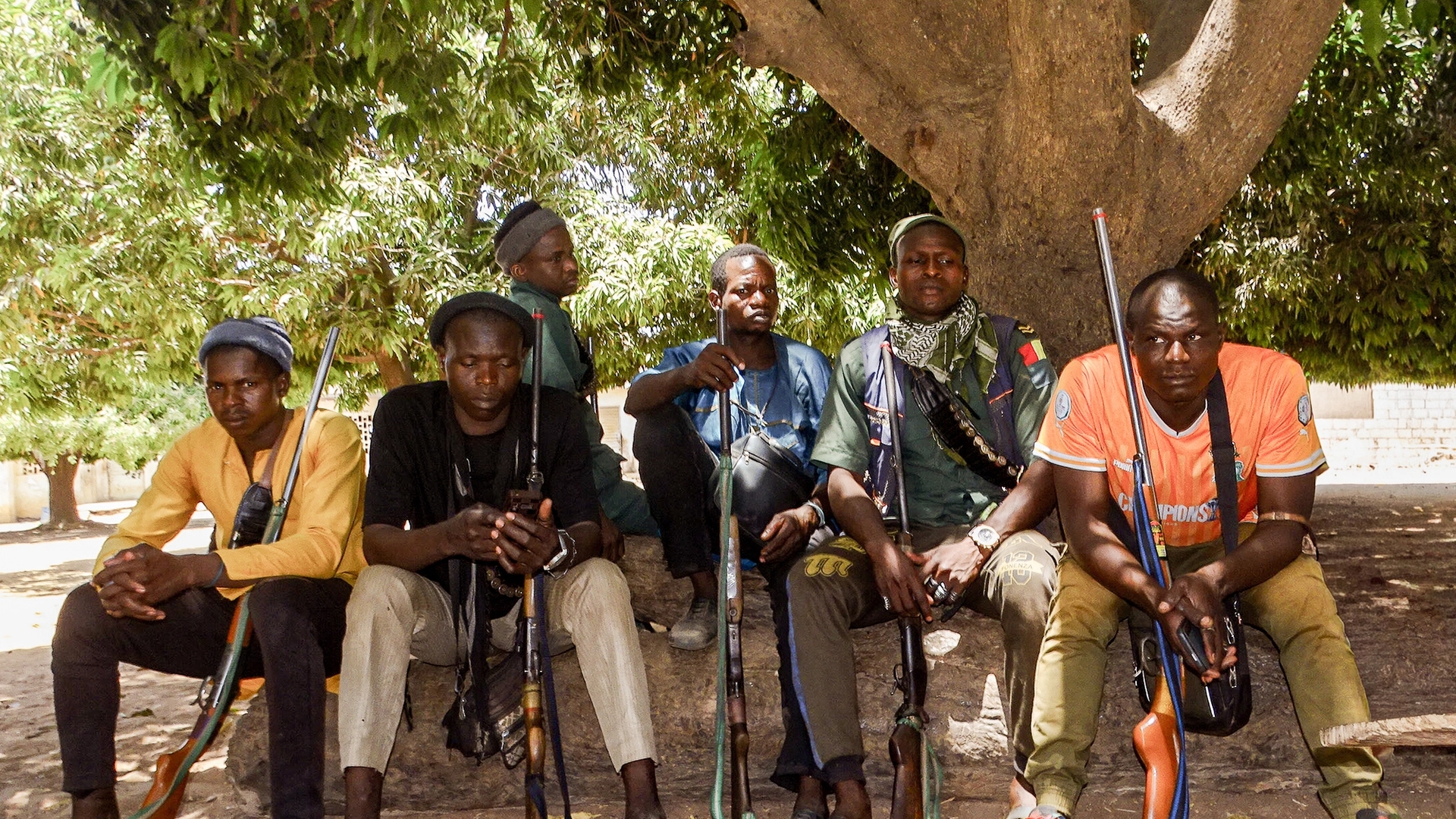
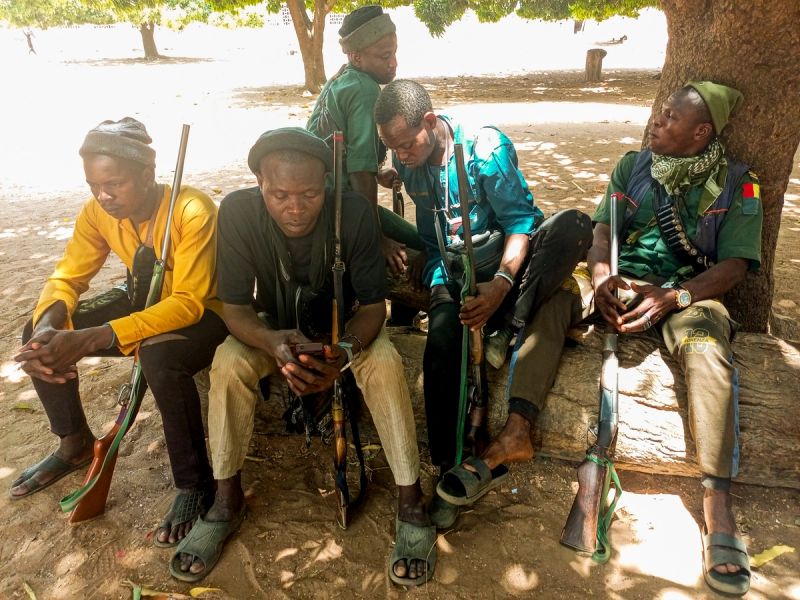
Members of the Gawezi Hunters Association rest in the shade between patrols near the Benin-Nigeria border. Photo: Anonymous, 2026
AFTER THE MOSQUE ATTACK, GAWEZI DID ITS DUTY: A STUDY IN GRASSROOTS RESILIENCE
Author: Annonymous
Death Came Alongside Fajr, and So Did Duty
Sanni Taïrou sat on the exposed root of a mango tree large enough for its shadow to shelter about six of us. He is a svelte, frail old man whom everyone calls Toéki (the spiritual chief of the traditional hunters) and addresses with reverence. His first few words, just minutes into our encounter, told me why: "Here, we begin our rituals with a formula that reconnects us with our roots and tradition. We say, 'What our forefathers did, they left it for us to do.' That is exactly what I did when this crisis started. This was our responsibility, nothing to be personally proud of. I worked with the chef de terre, the hunters, and the people of our village. It was our duty."
In mid-October 2025, a group of suspected Islamist militants (locals refer to them as "the Mahmuda") coming from the neighbouring Nigerian territory entered a mosque at Fajr, the Muslim dawn prayer, in the village of Gawezi. The imam, Ba Mora Ali, had just completed two rakats when the assailants opened fire on the worshippers, killing him and more than half a dozen men and women. "A few survived only because they had lain on the bodies of victims," Toéki told me. "With blood all around, they couldn't distinguish the living from the dead anymore, so they shouted 'Allahou Akbar!' and left the scene."
When I asked Toéki how he felt after witnessing the attack, he gave me a long, expressionless stare. "I was angry. And then we did our duty."
Gawezi lies on the western edge of Nigerian territory, just two kilometres through the bush to the Benin-Nigeria boundary demarcation markers. The small Boo ethnic community that lives here, otherwise known as the Bousanke people, functions by a set of four traditional authority figures. The king is the village's political authority. He was gone shortly after the attack, effectively leaving the crisis response to the three other pillars. Toéki is one of them. As the spiritual chief of the hunters, Toéki's duty was to advise the chef de terre, the second-highest traditional authority after the king, who governs and protects the land, and to spiritually strengthen the hunters to lead the crisis response.
"We did rituals to create a spiritual, invisible fence wall around the village and spiritually prepared the hunters to protect the villagers," Toéki explains. Throughout our hour-and-a-half-long conversation, he consistently explained his actions using the plural pronoun "we," while his emotions remained singular. "I am not working alone," he clarified, to appease my curiosity. As he described it, when a crisis of that nature occurs in the community, the response of the four traditional authority pillars is always a collective effort: "First, the king is informed; then we, the king, the chef de terre, the spiritual chief, and the hunters, all contribute our respective roles to lead our village through the situation."
Bearing "One Love" on the Stock of a Rifle
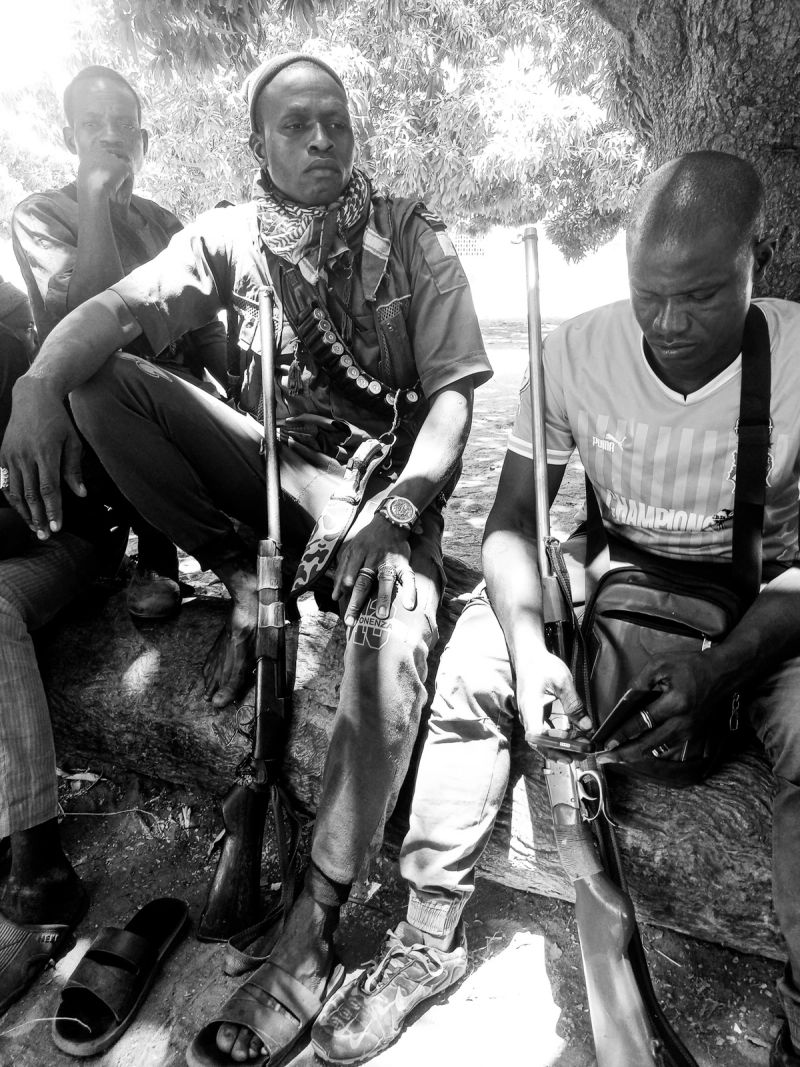
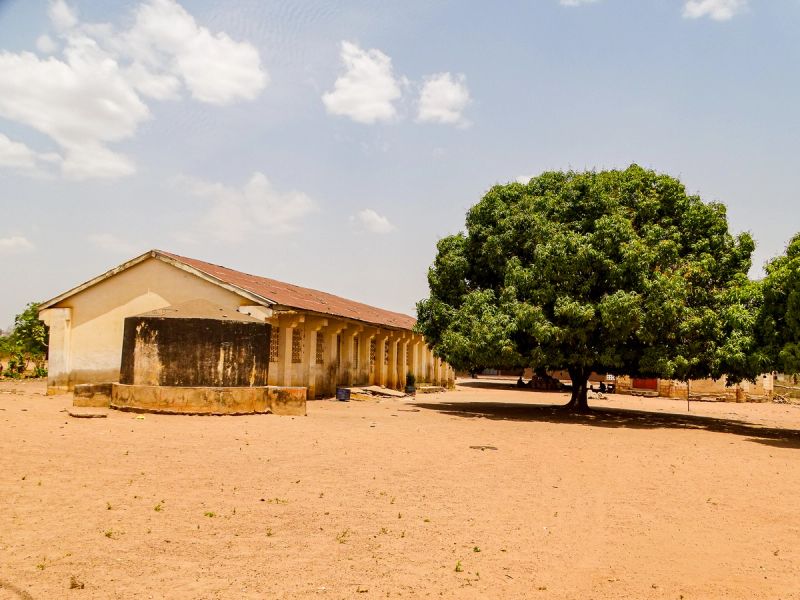
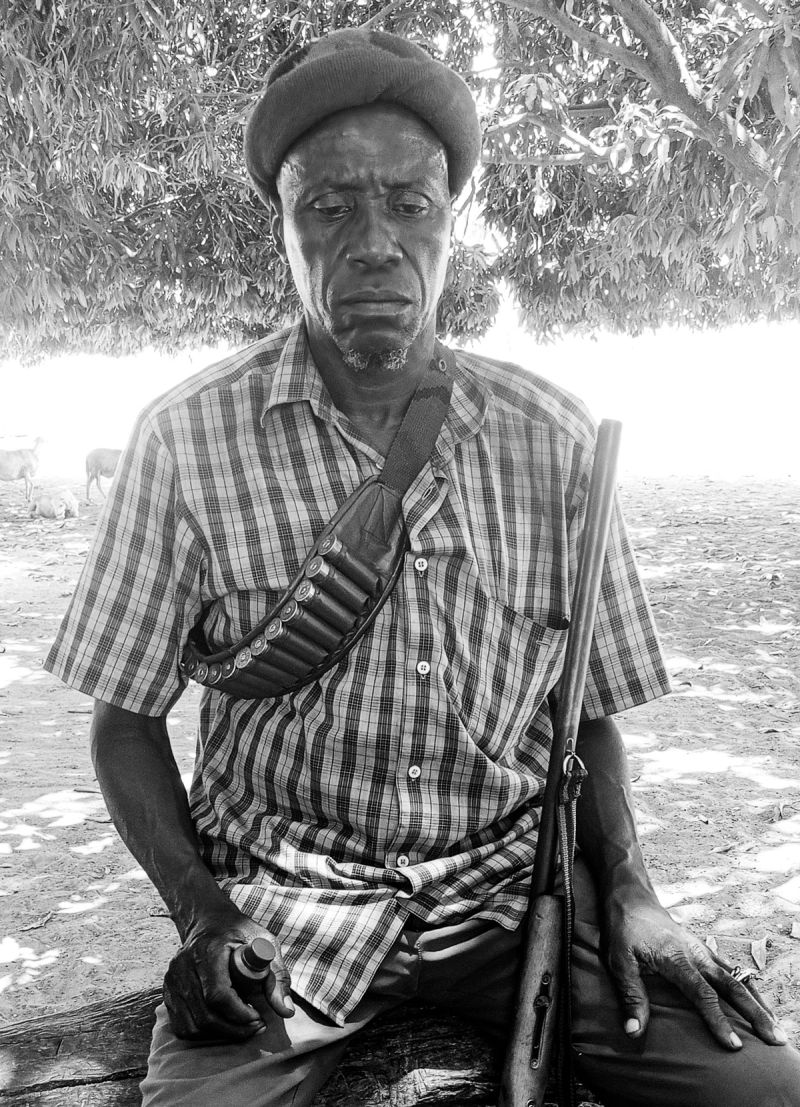
"There were few signs that this was impending," Bah Toko Mohamed told me. "We saw some individuals roving around in a surrounding farm a few days earlier, using their cattle as cover, nothing more." Bah Toko chaired the hunters' association in Gawezi for more than a decade, when the forest was still safe enough to hunt small game for the community's survival. I met him in the yard of the village's only primary school, under the canopy of a dozen mango trees. He spoke in a flat voice, half lying on the barrel of a calibre-12 shotgun, with a worn-off sticker of Bob Marley on its large wooden stock alongside a green-and-yellow inscription: "One Love." I was surrounded by several much younger men, each with his own rifle, and yet I clung to that almost inoffensive fading sticker on Bah Toko's gun to reassure myself as our conversation went on.
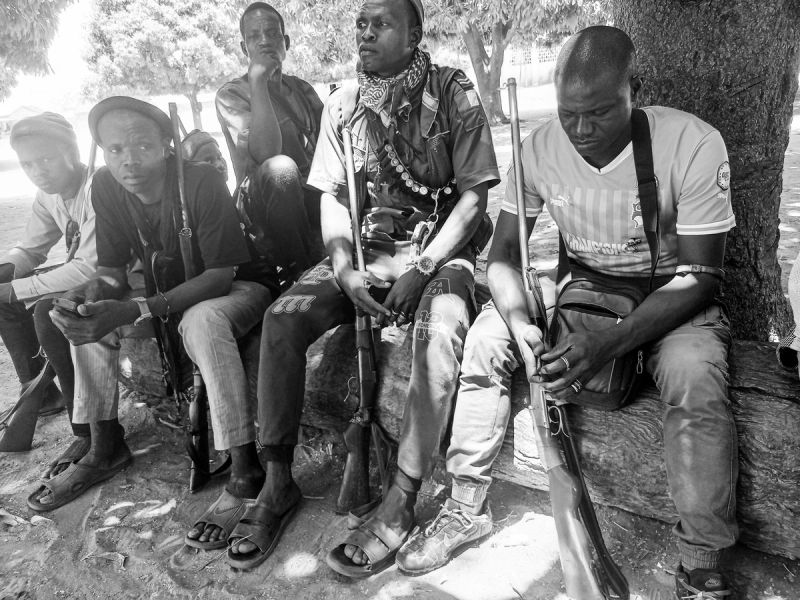
Hunters, within the Boo traditional organization, have historically served as protectors of the communities. They would occasionally fight the village's wars when there were wars to be fought, and, most of the time, they would scare dangerous wildlife away from the village. Thus, my host noted, protecting the community was not, per se, a new role for him and his group to assume in the aftermath of the October incidents, although the circumstances were new.
One younger hunter captured these new circumstances by interjecting in the flow of our conversation: "Our weapons don't match their firepower." Bah Toko swiftly dismissed the remark: "Maybe, but we have our fetishes and the spiritual defense of the elders." He went on, describing how they organized the protection of the community by installing checkpoints on the exits of the village and patrolling the road between Gawezi and neighboring villages in collaboration with hunters from those villages, including Lou and Daganzi to the southeast and Gorogao on the other side of the Nigerian border, to the east. Still, at that moment, I could not take my eyes off the Bob Marley sticker on the stock of his gun.
Another sign of the newness of the circumstances, Bah Toko admitted, is that "not everyone is happy with our activities."
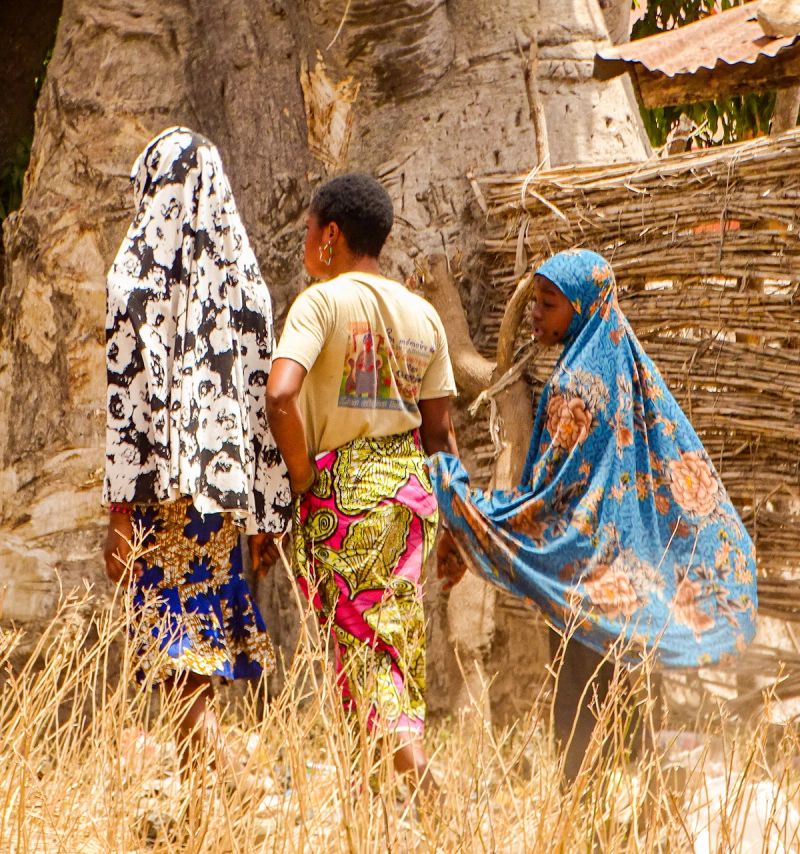
Trade, especially in staple commodities and some agricultural goods, rhythms community life in Gawezi. During my few hours' stay, I witnessed two eighteen-wheeler merchandise trucks passing through the village, likely from Nigeria. Women and youth would travel to the two largest cross-border market hubs: the Sunday market in Basso and the Monday market in Babana, on the Nigerian side, or to Bessassi on Friday. "We would escort women. An armed hunter carries up to two women on his motorcycle along the road. Yet not many traders like to be searched in and out of the village," Bah Toko explained. The community must also contribute money or food to sustain the hunters' operations, which are carried out in parallel with active scrutiny of travelers by Beninese and Nigerian security forces.
"We have excellent relations with the Beninese military," Bah Toko said in response to my question, more willing to elaborate on the traditional authorities: "Our village's chef de terre and spiritual chief give us the strength to carry on our duty."
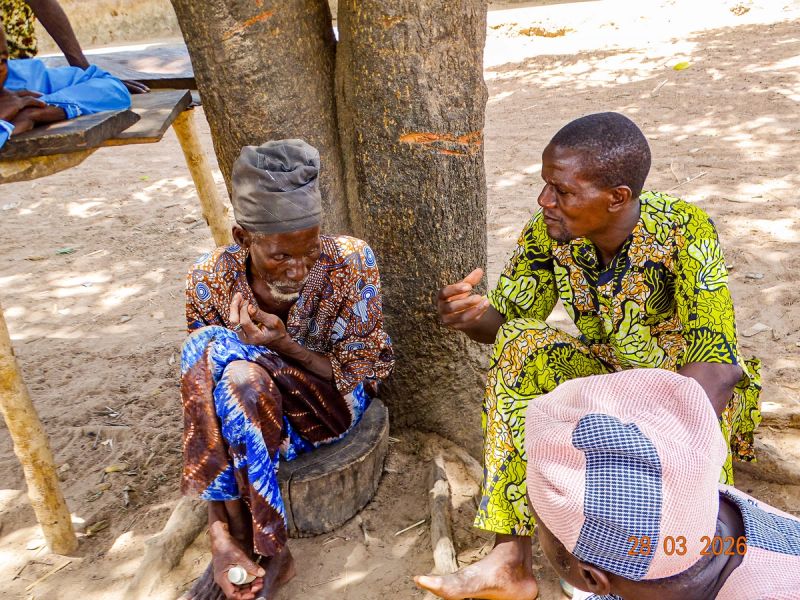
As the spiritual chief, Toéki would seek the protection of the community's deities for the village: Gaina, the river deity; Gbeaban, the stone deity; Planabio, the iron twin deities; and Kigande, a divinized human prince who is believed never to have faced defeat in any wars of his time, until he peacefully rested at the roots of a giant shea tree I later visited on the outskirts of the village. "Our heritage falters with orality, and people forget their onetime totems. That is what brings about times like this one. But times like that brought us back to our heritage," Toéki half complained. At first, I did not know what to make of this remark, nor did I fully rationalize how deeply rooted the community's resilience is in its beliefs and identity, until I met Na Madame.
It Is Not Only About Today's Struggles: Resilience Is Also Rooted in a Shared History
My only regret, leaving Gawezi, was not knowing the real name of Na Madame. She earned her nickname, I was told, having been the most elegant woman in the village in her youth. I met Na Madame at the chef de terre's compound, just a few meters south of the mosque that was hit on that fateful October dawn. She is not the chef de terre herself, although one could describe her as the last memory of countless chefs de terre she certainly outlived. My guide, her great-grandson, believes she may be more than a hundred years old: "We stopped counting when there was no one left to truly remember." Her grandnephew, the chef de terre, being absent, almost accidentally unearthed the discreet leadership Na Madame displayed during the crisis.
"Many households started to leave the village; they wanted to relocate elsewhere," she mumbled. "He asked for my advice, and I told them, 'Look around. All the villages around us are where they are today because a war or a crisis once displaced them from where they initially settled. They uprooted themselves. Gawezi never did. It is your duty to protect these families. Let them go if they are afraid, then settle the crisis and call them all back in.' That is what I said. That is our duty."
Na Madame, I was told, never left the village during the crisis, although many women and children temporarily sought harbor in relatives' households one or two villages away. "The king may leave, but the chef de terre and their family must stay, because that is how you know the village wasn't uprooted," her great-grandson explained. "Our village will survive this. We saw other struggles, and we prevailed."
The story has it that Bio Guera, one of Benin's best-known anticolonial resistance fighters, was trained in Gawezi in the nineteen-tens. All the figures I had met so far alluded to that history as a shared byte of identity pride that holds the village together in times of crisis. My conversation with Na Madame made this history even more vivid. "Have you met the hunters?" she asked. Then she continued, not waiting for my confirmation: "The primary school where they gather today was the training camp where, yesterday, this village hardened Bio Guera up. We fought our past battles here; we'll win our newest ones here, too."
I found little historical evidence of Na Madame and others' assertion that Bio Guera trained in Gawezi. Although a few words from a popular song I unconsciously sang all my childhood in Baatonou suddenly made sense to me: "Bio Guera Gbaasi ka duman Nikki daa." "Right?" Na Madame argued. "Gbaasi is just a few kilometers northwest of here, near Bouka. That is where he was born. Here, his nickname was Kaasè, the man who rides a white horse. Gawezi is where he became a warrior. This village always stood up to its struggles."
A high-quality pen begins as raw materials: brass rod, gold sheet, engineered resin. Each component is machined and turned to tight tolerances prior to assembly. Barrel and cap are lathe-turned and polished through progressive grits; metal fittings are stamped, milled, and plated separately. The nib requires the greatest labor: stamped from gold sheet, tipped with an iridium-group alloy harder than the gold itself, then split, ground, and tested for ink flow by hand under magnification. It is adjusted and re-tested until it meets specification. The pen is then assembled manually, inked, and written with before it leaves the bench.
Stories

STAY UPDATED
Sign up to be the first to find out when new stories and merch drop on THROAT. We respect your privacy and will never share your information with any third-party vendors. For real.