
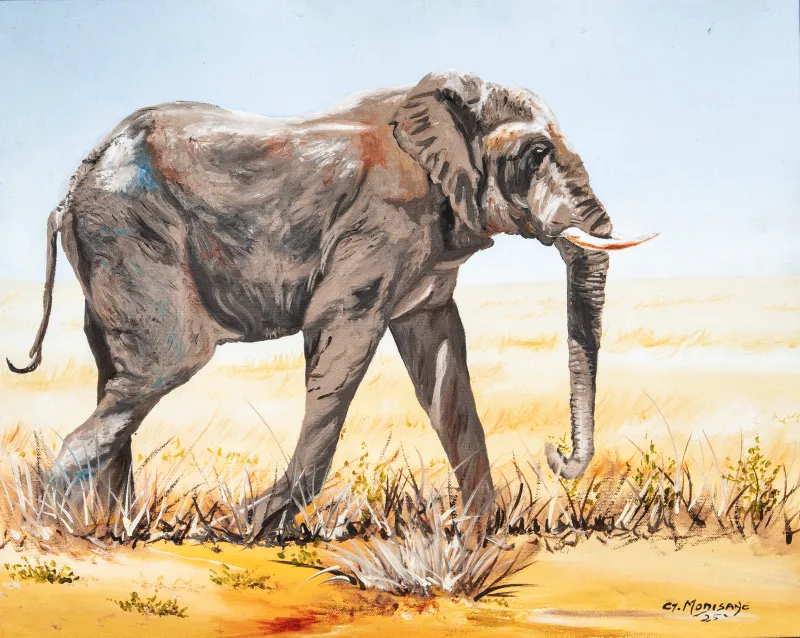
Elephants, Tijane Geomeone Modisane, 2025. Medium: Painting, W 97× H 66 cm
Materials: Oil on Canvas, Style: Realism, Signature: Yes, Framed: No
Botswana's Bet: How a Diamond Economy Learned to Count Its Elephants
Author: THROAT
The numbers coming out of Botswana's Chobe National Park don't lie, though for decades the bureaucrats responsible for managing one of Africa's most extraordinary ecosystems behaved as though they did. Chobe is home to the world's largest population of African elephants, and to the African wild dog, a species teetering on the edge of extinction. It sits within the Kavango-Zambezi Transfrontier Conservation Area, a cross-border expanse of wilderness that spans five countries and constitutes the largest land-based transboundary conservation area on earth. For years, the government in Gaborone collected entrance fees from the tourists who came to witness all of this, and it hadn't bothered to revise those fees in over two decades.
That changed in April 2022. Park entrance fees went up for the first time since 2000, when the revision, under Statutory Instrument No. 3 of 2021 and took effect on April 1, 2022. In their first year under the new structure, the fees generated US$7.8 million — more than three times the projected US$1.8 million that planners had anticipated. The system has since been rolled out nationally. It is, by any measure, a modest reform. But in the context of how conservation finance actually works, or more often fails to work, it represents something more significant: a government finally deciding to price what it had long been giving away.
The deeper story here is not about elephants. It's about what happens to an economy that has built itself almost entirely on diamonds and is now, with some urgency, looking for a second act.
Botswana's dependence on mineral extraction is not a secret. The country has managed that dependence more responsibly than most of its neighbors, but the logic of a single-commodity economy is not complicated: when the commodity runs out, or when the market for it collapses, the economy follows. Tourism, particularly the high-value, low-volume model that Botswana has pursued in places like Chobe and the Okavango Delta, offers a different calculus. The wildlife corridors and intact ecosystems that make Botswana attractive to the kind of tourists who spend serious money are also, it turns out, worth protecting for reasons that have nothing to do with sentiment.
The financing architecture behind this shift is worth examining closely. The Global Environment Facility, working through the United Nations Development Programme's Biodiversity Finance Initiative and with funding from Germany, the United Kingdom, and the European Union, provided the catalytic support that allowed Botswana to develop and pilot new financing solutions for its protected areas. Community Conservation Trusts, community-based organizations that engage local populations in managing wildlife and ecosystems, emerged from this work, with the explicit goal of reducing the human-wildlife conflict that has historically pitted subsistence farmers against the very animals that draw tourists to the region.
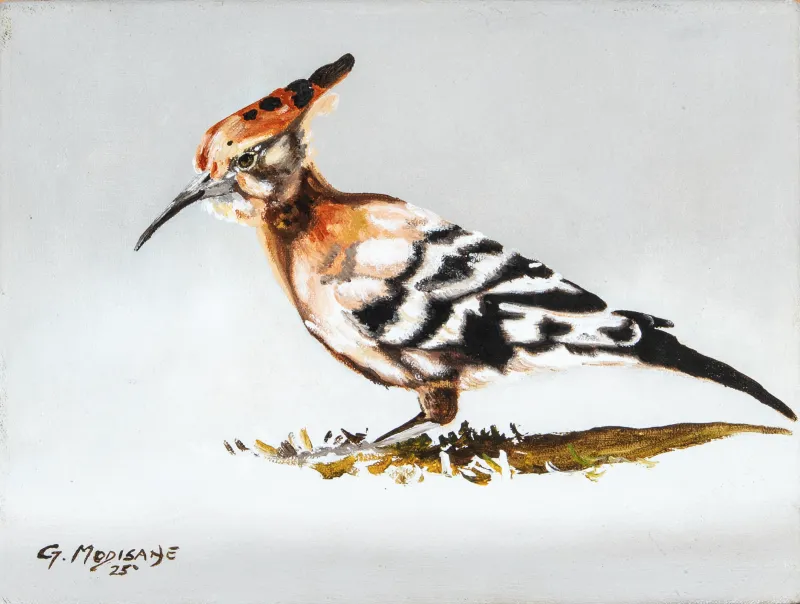
The infrastructure is following the money. The Kazungula Bridge, a US$259.3 million span linking Botswana and Zambia across the Zambezi River, was commissioned in May 2021 with financing from the African Development Bank — which provided a US$76.5 million loan to Zambia — alongside an EU-Africa Infrastructure Trust Fund grant and the Japan International Cooperation Agency. It is presented, with some justification, as a project that serves both conservation and commerce simultaneously, opening trade routes along the North-South Corridor that stretch as far as Tanzania and the Democratic Republic of Congo. Whether the commercial pressures it enables will ultimately serve or undermine the ecosystems it crosses is a question that tends to get lost in the promotional literature.
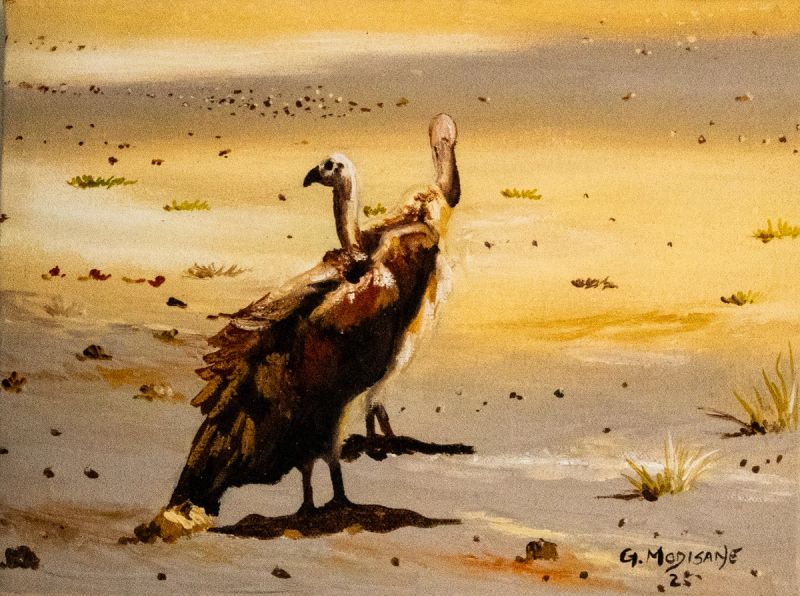
The private sector is arriving, carefully. BirdLife Botswana and Botswana Ash Ltd. are protecting flamingo habitats in the Sua and Makgadikgadi Pans. Banks and insurance providers are being pushed, through reforms still in progress, to assess environmental risk as a component of ordinary financial decision-making. Carbon markets are next. A national Carbon Market Framework is in development, designed to leverage Botswana's forests, rangelands, and fire management systems as tradable climate assets.
Zambia, watching from across the Zambezi, is already moving. In December 2023, Copperbelt Energy Corporation registered a US$200 million green bond programme through its subsidiary CEC Renewables, with proceeds earmarked for solar energy projects designed to reduce the country's reliance on hydropower and, by extension, slow the deforestation that hydropower dependency accelerates. The programme is not a single issuance. As of December 2024, two tranches had been raised: US$53.5 million in January 2024, oversubscribed by 178 percent, and US$96.7 million in December 2024, oversubscribed by 230 percent — bringing the total raised to approximately US$150.2 million against the US$200 million ceiling.
None of this is guaranteed to work. Conservation finance has a long history of producing frameworks that look compelling on paper and dissolve on contact with political reality. The pressure on Chobe and the broader KAZA landscape is not abstract. Poaching, deforestation, and the encroachment of development on wildlife corridors are ongoing. The fee reform generated US$7.8 million in a single year, which sounds like progress until you consider the scale of the threats it is meant to address.
What Botswana has demonstrated, with more consistency than most countries in its position, is a willingness to treat its natural heritage as a balance sheet asset rather than a backdrop. That is not a small thing. It is, in fact, the precondition for everything else.
Sources
African Development Bank. (2021, May). Kazungula Bridge Project to expand regional integration and trade across southern Africa. https://www.afdb.org/
BIOFIN. (n.d.). Botswana’s new protected area fees generate US$7.8 million, more than projected. https://biofin.org/
BIOFIN. (n.d.). Footprints of the Biodiversity Finance Initiative (BIOFIN) in Zambia’s maiden green bond issuance. https://biofin.org/
PANORAMA/UNDP. (n.d.). Updating protected area fees in Botswana: Aligning prices with current market values through an evidence-based and participatory process. https://panorama.solutions/
Southern African Development Community. (2021, May). US$259m Kazungula Bridge and One Stop Border Post Commissioned, paving way for enhanced SADC integration and development. https://www.sadc.int/
UNDP. (n.d.). Botswana’s jewel: How unlocking investments in nature can drive economic prosperity for all. https://www.undp.org/africa
UNDP Zambia. (2024, December). Zambia’s bold step toward a greener future: CEC-R secures $96.7 million green financing. https://www.undp.org/zambia
I paint Botswana.
Not the version on postcards. The real one—elders on dirt roads, women at work, wildlife that doesn't know it's being watched.
I never went to art school. In 2004, I walked into the Thapong Art Centre and learned from workshops, exhibitions, and artists who were further down the road than me.
The government of Botswana commissioned me to build the 50th-anniversary independence monuments across four towns. I wore overalls and got it done.
I have competed twice and placed second both times. I'll take that.
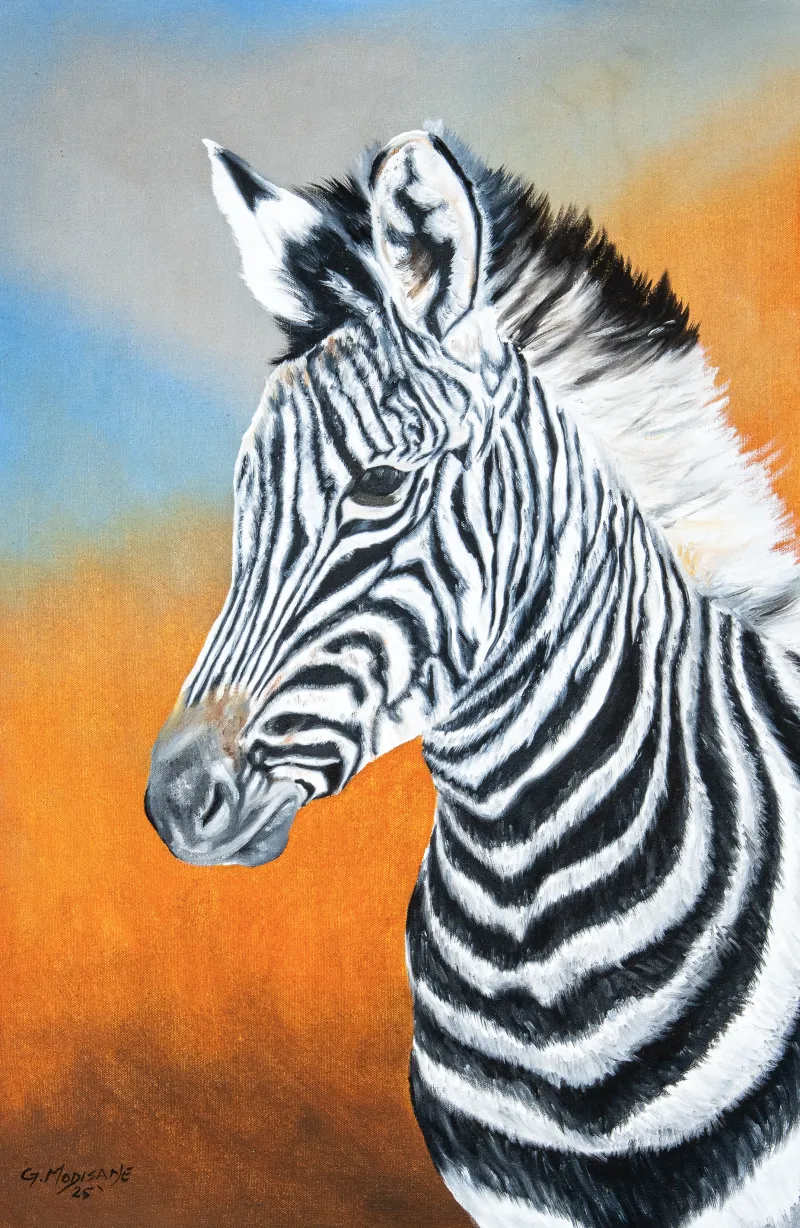
Colour is what drives me. Always has been. The ochre of the soil, the cold of early-morning light, the way a zebra's stripes hold against dry grass. I don't choose the colours. They choose me.
This is my country. I'm just paying attention to it.
Geomeone Modisane's work can be viewed at the Thapong Visual Arts Centre located in Gaborone, Botswana.
Stories

STAY UPDATED
Sign up to be the first to find out when new stories and merch drop on THROAT. We respect your privacy and will never share your information with any third-party vendors. For real.